Published by:
CGP EDU Academic Team
Published on: September 12, 2026
Match the List-I with List-II.
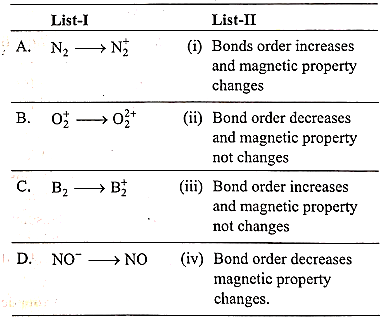
Choose the correct answer from the options given below.
Text Solution
Verified by ExpertsThe correct answer is:
A
Step 1: Analyze the changes in bond order and magnetic properties for each transformation.
1. **A. N2 → N2+**
2. **B. O2 → O22+**
3. **C. B2 → B2+**
4. **D. NO- → NO**
Conclusion: The correct pairs are A-(iv), B-(ii), C-(i), D-(iii). Therefore, the answer is option A.
1. **A. N2 → N2+**
- Bond order of N2 is 3 (as both the bonds are sigma and two pi bonds).
- For N2+, removing one electron from the antibonding orbital decreases the bond order to 2.5.
- Since positively charged species typically have fewer unpaired electrons, the magnetic property may change. Therefore, this matches with (iv): Bond order decreases and magnetic property changes.
2. **B. O2 → O22+**
- Bond order of O2 = 2.
- For O22+, two electrons are removed from the antibonding pi orbitals, yielding a bond order of 2 as well.
- As both species are diatomic, their magnetic properties do not change. Hence, this corresponds with (ii): Bond order decreases and magnetic property not changes.
3. **C. B2 → B2+**
- Bond order of B2 is 1.
- For B2+, one electron is removed from a bonding orbital, leaving the bond order at 0.5.
- This results in an increase in bond order (going from 1 to 0.5), but its magnetic property doesn’t change since it remains paramagnetic.
- Thus, this matches with (iii): Bond order increases and magnetic property not changes.
4. **D. NO- → NO**
- Bond order of NO- is 2.5.
- In NO, one electron is removed thus increasing it to a bond order of 3.
- Similarly, the magnetic property doesn’t change, so this corresponds with (i): Bond order increases and magnetic property changes.
Conclusion: The correct pairs are A-(iv), B-(ii), C-(i), D-(iii). Therefore, the answer is option A.
Prepare Smarter with CGP Edu
Get practice questions, solutions, and test series in one place.
Write a Review
Share your experience with this question and solution.
Commentary
Send your comment, doubt, correction, or feedback to admin.
Similar Questions
Explore conceptually related problems
Sodium carbonate cannot be used in place of for the identification of and (in group ) during mi…
Consider the following statements about - and -block elements.
(I) The colour of is due to tran…
A translucent white waxy solid on heating in an inert atmosphere is converted to its allotropic fo…
Which of the following compounds will produce on heating?
What is the standard electrode potential for the electrode in solution? (Given: volt,
Which one of the following represents correct order of basic strength?